Every year in southern California, market squid (Loligo opalescens) lay their eggs in clusters along the sea floor, sometimes covering acres in a single area. These attract a plethora of critters, and you never quite know what you'll encounter.
Showing posts with label sea. Show all posts
Squid Eggs: The Main Attraction
Written by
Unknown
Every year in southern California, market squid (Loligo opalescens) lay their eggs in clusters along the sea floor, sometimes covering acres in a single area. These attract a plethora of critters, and you never quite know what you'll encounter.
Diving the Oil Rigs: Behind the Scenes
Written by
Unknown
Dive down, swim around, and come back up. Sounds easy enough, right? Well, that's pretty much how my dives were before I was introduced to the wonderful world of underwater photography. It's not quite that straight-forward these days. Don't get me wrong. The fact that I have the opportunity to pursue this passion is one that I appreciate every time I dip below the surface.
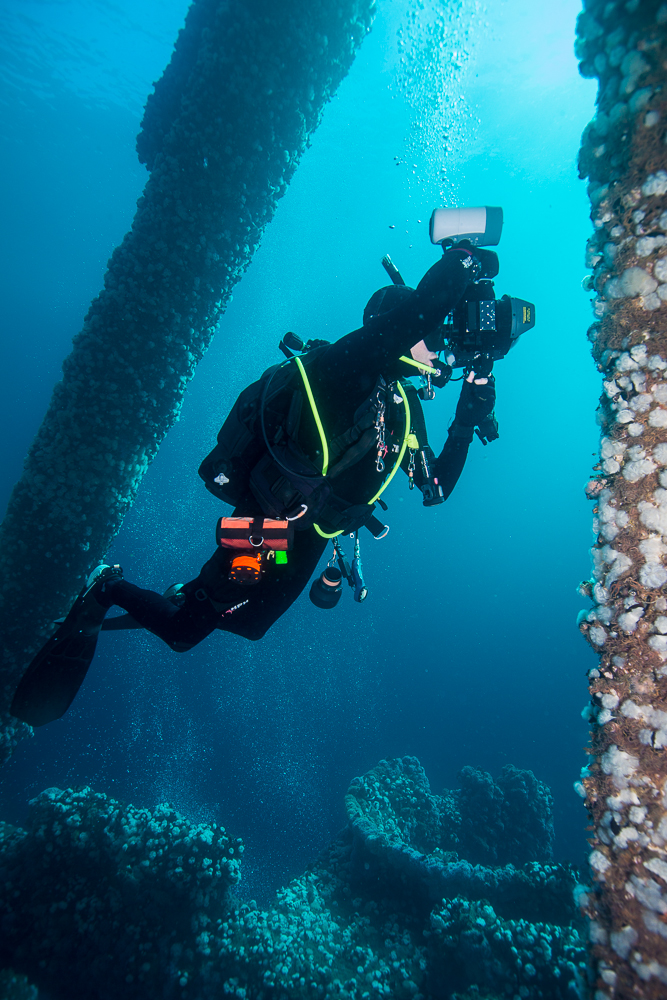
My goal here is to give you a glimpse into what is involved in capturing a photo underwater. Today we'll be taking a journey to one of my favorite dive sites; the oil rigs which are just offshore of Huntington Beach, California.
My first priority is prepping the camera. After charging the batteries for the camera and strobes (flashes), I begin by assembling the camera in the underwater housing. My particular housing (Sea & Sea) is made from a solid block of aluminum, and it's made specifically for my Nikon D7000 dSLR camera. It is made waterproof to 330 feet thanks in part to a series of o-rings. Once I've checked the integrity of the o-rings, assembled the housing, and attached the strobes, I'll take a test shot to ensure the system is working properly.
Then it's off the garage to put together my scuba gear (aka life support). I don't take this task lightly, and check to make sure every component of my equipment is working correctly. A few days before the trip, I take my cylinders to my local dive shop (Ocean Gear) to get filled with either air or nitrox (a gas mixture containing more oxygen than air (>21%)). The gas mixture I choose to use is based on the planned dive sites, and the maximum depth to which I'll be going.
Like assembling my housing, it takes about 20 minutes to put my scuba gear together. This includes, but is not limited to, my wetsuit, mask, fins, gloves, tank, regulator, and weights.
Ok, so after prepping my camera and scuba gear the night before the trip, I've made it to the boat, and we make our way a few miles out to the oil rigs. My buddy Todd Winner and I head down to the depths and look for cool structure and critters to photograph.
![]() |
| With camera in-hand, I'm about to hop in for dive #2. Photo courtesy of Todd Winner. |
![]() |
| My buddy Todd photographs me as I'm composing the shot you see below. |
Once I have the settings dialed-in, I wait patiently until the right moment to capture the image I have envisioned. In this case, I wait until this female sheephead is in front of the camera and will be lit up by my strobe light.
![]() |
| The finished product. This image was captured at 80 feet below the surface of the ocean. The structure I'm photographing leads you all the way up to the surface. |
This was just one of many images I captured that day, and I've shared a few more below. I certainly hope you enjoyed this sneak peek behind-the-scenes as to what goes into creating an image underwater. Drop me a line if you have any questions!
Special thanks to Captain Kyaa at Selky Charters for a great day of diving!
More images from the oil rigs
![]() |
| A large Metridium (plumose) anemone growing at 110 fsw. Looking up through the opening you can see the other side of the structure in the distance. |
![]() |
| The sea lions decided to come out and play when I had only five minutes of air left. Gee thanks. |
![]() |
| A giant-spined sea star clings to a piling covered with anemones, brittle stars, and mussels. The yellow beams are support beams for the oil rig above the surface. |
Otherworldly
Written by
Unknown
Once in awhile I'm treated to diving a site I have yet to experience. On a recent charter with Bluewater Photo, we dove Eagle Rock at the west end of Catalina Island. The site is based around a large rock structure that reaches high into the air, and plunges to a depth of 120fsw (feet sea water).
Circumnavigating Eagle Rock is really easy, which allowed me to focus on the photographic potential of this new site. Typically, when diving a new site in southern California, I am much more concentrated in familiarizing myself with the site and the navigation. Without a visual reference like this amazing rock structure, diving a new site demands a lot more focus on navigation, currents, et cetra.
Halfway into the dive, I found my first subject of interest. Now, I have seen plenty of sponges before, but this rather large gray moon sponge caught my attention. Shooting up at this sponge from a depth of 80fsw, I couldn't help but think that I was visiting another world. Its holes and craters seemed to fit right in with the dramatic structure of the site. These sessile animals (yes, sponges are animals) survive by filtering their food from the surrounding environment.
Having such great subjects as the gray moon sponge, moon jelly, and man-made-looking underwater structure made this dive memorable. You just never know what you're going to encounter when you dip below the surface.
Comedic author Dave Barry once said, "There's nothing wrong with enjoying looking at the surface of the ocean itself, except that when you finally see what goes on underwater, you realize that you've been missing the whole point of the ocean. Staying on the surface all the time is like going to the circus and staring at the outside of the tent." Well said, Dave.
Be sure to catch my next post by simply entering your email address below where it says "Follow By Email."
Circumnavigating Eagle Rock is really easy, which allowed me to focus on the photographic potential of this new site. Typically, when diving a new site in southern California, I am much more concentrated in familiarizing myself with the site and the navigation. Without a visual reference like this amazing rock structure, diving a new site demands a lot more focus on navigation, currents, et cetra.
![]() |
| That's me climbing back onto the Pacific Star after an amazing dive at Eagle Rock. Photo courtesy of David McGuire from Shark Stewards. |
Halfway into the dive, I found my first subject of interest. Now, I have seen plenty of sponges before, but this rather large gray moon sponge caught my attention. Shooting up at this sponge from a depth of 80fsw, I couldn't help but think that I was visiting another world. Its holes and craters seemed to fit right in with the dramatic structure of the site. These sessile animals (yes, sponges are animals) survive by filtering their food from the surrounding environment.
![]() |
| A large gray moon sponge stands proudly on the reef at the base of Eagle Rock. |
As I cruise clock-wise around this gorgeous structure, I'm treated to an amazing natural A-frame swim-through against the main reef. The straight lines and hard angles challenge my understanding that this site is not man-made. The only element that would make an image of this cool structure successful is a dive model. Suddenly, I feel a tap on my shoulder and realize it's my friend Dana. She points to the swim-through and indicates that she wants to model for me. Awesome! Being a photographer too, Dana saw the potential for this shot. We were definitely on the same page.
After photographing some mussels in the shallows, I met up with my buddy Todd and we started kicking back to the boat. This is when we were treated to a rare moon jelly near the surface. Todd pulled over some kelp floating nearby, which added to the depth of the photo below.
![]() |
| My buddy Todd Winner looks longingly at a moon jelly. It's so great to spot a fun subject on the way back to the boat! |
Having such great subjects as the gray moon sponge, moon jelly, and man-made-looking underwater structure made this dive memorable. You just never know what you're going to encounter when you dip below the surface.
![]() |
| Todd and I shooting the moon jelly at the surface on our way back to the boat. Photo courtesy of David McGuire. |
Comedic author Dave Barry once said, "There's nothing wrong with enjoying looking at the surface of the ocean itself, except that when you finally see what goes on underwater, you realize that you've been missing the whole point of the ocean. Staying on the surface all the time is like going to the circus and staring at the outside of the tent." Well said, Dave.
Trip Report: Anacapa Island
Written by
Unknown
Rarely do I pass up an opportunity to go diving at the Channel Islands, and last Friday was no exception. This time it was an invite from my buddy Mike Bartick to head to Anacapa Island to dive the Pelican Reserve. A quick internet search turns up some interesting information. According to the National Park Service, the California brown pelican was classified as federally endangered in 1970, and as endangered by the state of California in 1971. The only breeding colonies of California brown pelicans in the western United States are within Channel Islands National Park on West Anacapa and Santa Barbara Islands. So, in order to help protect the ailing pelican population, the site known as Pelican Reserve is only open to divers two months of the year: November 1 through December 31. Sweet! Let's do this. . . .
Pelican Reserve
Mike
and I hopped off the Spectre and immediately headed to deeper waters, in search
of torpedo rays. During our descent, I couldn't help by notice that the
entire reef was completely covered in brittle stars. The reef is slowly being decimated by these colorful invaders. The reef finally
"cleared up" at about 20fsw, where I found the occasional gorgonian.
Goldfish Reef
Our
next dive took us to Goldfish Reef toward the west end of the island. The
sun came out, which is typically when I shoot wide-angle, but Mike mentioned the
possibility of finding pike blennies, which I have never seen.
Macro it is. . . .
I'm so stoked that I switched! Our search for pike blennies was a bust, but we did witness dozens of Navanax inermis mating. Eggs were everywhere, and I had never seen so many Navanax at one site before.
Macro it is. . . .
I'm so stoked that I switched! Our search for pike blennies was a bust, but we did witness dozens of Navanax inermis mating. Eggs were everywhere, and I had never seen so many Navanax at one site before.
![]() | |
|
After a brief encounter with a Giant Sea Bass, and with just five minutes of bottom time to spare, I spotted a rare Babakina festiva nudibranch. Wait . . . not one, but three! These tiny, colorful nudibranchs are about the size of a grain of risotto. How cool!
![]() | |
|
West End
Our
third and final dive of the day came at West End. The current was mild as was descended into the colorful
shallows, full of bright green eel grass and huge schools of opaleye.
![]() |
| Looking east from the west end of Anacapa Island. The currents can get intense here as the reef descends into the channel. |
I
found a short wall full of colorful urchins and anemones, just out of reach of the direct
sun. As I wrapped up a series of
frames, I noticed a substantial shift in the intensity of the current. Time to end the dive. Special thanks to Mike Bartick, and the crew of the Spectre!
Subscribe to:
Posts (Atom)