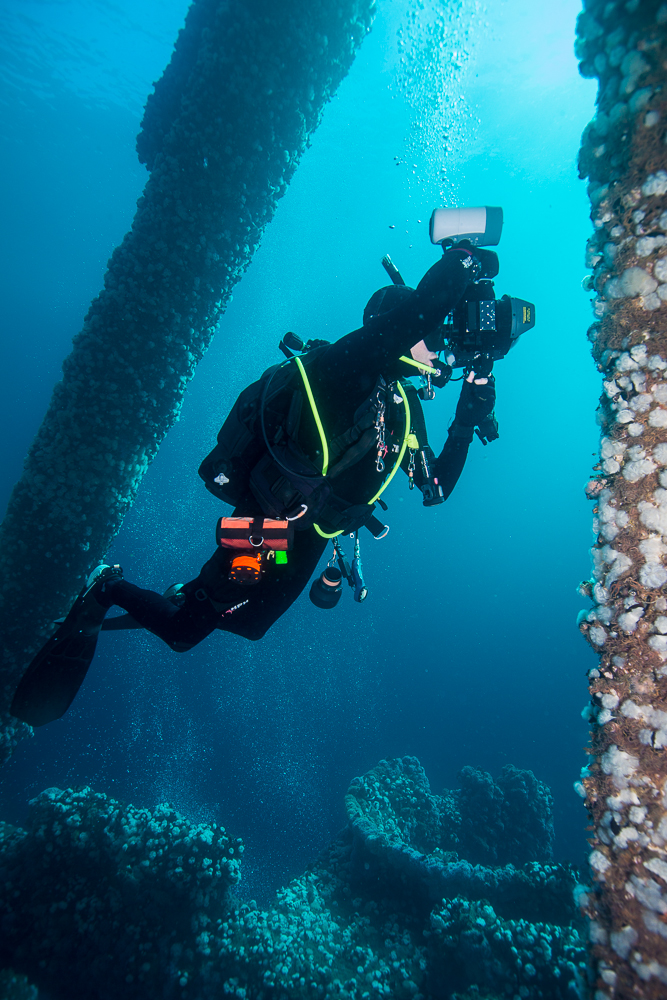
Every year in southern California, market squid (Loligo opalescens) lay their eggs in clusters along the sea floor, sometimes covering acres in a single area. These attract a plethora of critters, and you never quite know what you'll encounter.
Showing posts with label ocean. Show all posts
Squid Eggs: The Main Attraction
Written by
Unknown
Every year in southern California, market squid (Loligo opalescens) lay their eggs in clusters along the sea floor, sometimes covering acres in a single area. These attract a plethora of critters, and you never quite know what you'll encounter.
Diving the Oil Rigs: Behind the Scenes
Written by
Unknown
Dive down, swim around, and come back up. Sounds easy enough, right? Well, that's pretty much how my dives were before I was introduced to the wonderful world of underwater photography. It's not quite that straight-forward these days. Don't get me wrong. The fact that I have the opportunity to pursue this passion is one that I appreciate every time I dip below the surface.
My goal here is to give you a glimpse into what is involved in capturing a photo underwater. Today we'll be taking a journey to one of my favorite dive sites; the oil rigs which are just offshore of Huntington Beach, California.
My first priority is prepping the camera. After charging the batteries for the camera and strobes (flashes), I begin by assembling the camera in the underwater housing. My particular housing (Sea & Sea) is made from a solid block of aluminum, and it's made specifically for my Nikon D7000 dSLR camera. It is made waterproof to 330 feet thanks in part to a series of o-rings. Once I've checked the integrity of the o-rings, assembled the housing, and attached the strobes, I'll take a test shot to ensure the system is working properly.
Then it's off the garage to put together my scuba gear (aka life support). I don't take this task lightly, and check to make sure every component of my equipment is working correctly. A few days before the trip, I take my cylinders to my local dive shop (Ocean Gear) to get filled with either air or nitrox (a gas mixture containing more oxygen than air (>21%)). The gas mixture I choose to use is based on the planned dive sites, and the maximum depth to which I'll be going.
Like assembling my housing, it takes about 20 minutes to put my scuba gear together. This includes, but is not limited to, my wetsuit, mask, fins, gloves, tank, regulator, and weights.
Ok, so after prepping my camera and scuba gear the night before the trip, I've made it to the boat, and we make our way a few miles out to the oil rigs. My buddy Todd Winner and I head down to the depths and look for cool structure and critters to photograph.
![]() |
| With camera in-hand, I'm about to hop in for dive #2. Photo courtesy of Todd Winner. |
![]() |
| My buddy Todd photographs me as I'm composing the shot you see below. |
Once I have the settings dialed-in, I wait patiently until the right moment to capture the image I have envisioned. In this case, I wait until this female sheephead is in front of the camera and will be lit up by my strobe light.
![]() |
| The finished product. This image was captured at 80 feet below the surface of the ocean. The structure I'm photographing leads you all the way up to the surface. |
This was just one of many images I captured that day, and I've shared a few more below. I certainly hope you enjoyed this sneak peek behind-the-scenes as to what goes into creating an image underwater. Drop me a line if you have any questions!
Special thanks to Captain Kyaa at Selky Charters for a great day of diving!
More images from the oil rigs
![]() |
| A large Metridium (plumose) anemone growing at 110 fsw. Looking up through the opening you can see the other side of the structure in the distance. |
![]() |
| The sea lions decided to come out and play when I had only five minutes of air left. Gee thanks. |
![]() |
| A giant-spined sea star clings to a piling covered with anemones, brittle stars, and mussels. The yellow beams are support beams for the oil rig above the surface. |
Otherworldly
Written by
Unknown
Once in awhile I'm treated to diving a site I have yet to experience. On a recent charter with Bluewater Photo, we dove Eagle Rock at the west end of Catalina Island. The site is based around a large rock structure that reaches high into the air, and plunges to a depth of 120fsw (feet sea water).
Circumnavigating Eagle Rock is really easy, which allowed me to focus on the photographic potential of this new site. Typically, when diving a new site in southern California, I am much more concentrated in familiarizing myself with the site and the navigation. Without a visual reference like this amazing rock structure, diving a new site demands a lot more focus on navigation, currents, et cetra.
Halfway into the dive, I found my first subject of interest. Now, I have seen plenty of sponges before, but this rather large gray moon sponge caught my attention. Shooting up at this sponge from a depth of 80fsw, I couldn't help but think that I was visiting another world. Its holes and craters seemed to fit right in with the dramatic structure of the site. These sessile animals (yes, sponges are animals) survive by filtering their food from the surrounding environment.
Having such great subjects as the gray moon sponge, moon jelly, and man-made-looking underwater structure made this dive memorable. You just never know what you're going to encounter when you dip below the surface.
Comedic author Dave Barry once said, "There's nothing wrong with enjoying looking at the surface of the ocean itself, except that when you finally see what goes on underwater, you realize that you've been missing the whole point of the ocean. Staying on the surface all the time is like going to the circus and staring at the outside of the tent." Well said, Dave.
Be sure to catch my next post by simply entering your email address below where it says "Follow By Email."
Circumnavigating Eagle Rock is really easy, which allowed me to focus on the photographic potential of this new site. Typically, when diving a new site in southern California, I am much more concentrated in familiarizing myself with the site and the navigation. Without a visual reference like this amazing rock structure, diving a new site demands a lot more focus on navigation, currents, et cetra.
![]() |
| That's me climbing back onto the Pacific Star after an amazing dive at Eagle Rock. Photo courtesy of David McGuire from Shark Stewards. |
Halfway into the dive, I found my first subject of interest. Now, I have seen plenty of sponges before, but this rather large gray moon sponge caught my attention. Shooting up at this sponge from a depth of 80fsw, I couldn't help but think that I was visiting another world. Its holes and craters seemed to fit right in with the dramatic structure of the site. These sessile animals (yes, sponges are animals) survive by filtering their food from the surrounding environment.
![]() |
| A large gray moon sponge stands proudly on the reef at the base of Eagle Rock. |
As I cruise clock-wise around this gorgeous structure, I'm treated to an amazing natural A-frame swim-through against the main reef. The straight lines and hard angles challenge my understanding that this site is not man-made. The only element that would make an image of this cool structure successful is a dive model. Suddenly, I feel a tap on my shoulder and realize it's my friend Dana. She points to the swim-through and indicates that she wants to model for me. Awesome! Being a photographer too, Dana saw the potential for this shot. We were definitely on the same page.
After photographing some mussels in the shallows, I met up with my buddy Todd and we started kicking back to the boat. This is when we were treated to a rare moon jelly near the surface. Todd pulled over some kelp floating nearby, which added to the depth of the photo below.
![]() |
| My buddy Todd Winner looks longingly at a moon jelly. It's so great to spot a fun subject on the way back to the boat! |
Having such great subjects as the gray moon sponge, moon jelly, and man-made-looking underwater structure made this dive memorable. You just never know what you're going to encounter when you dip below the surface.
![]() |
| Todd and I shooting the moon jelly at the surface on our way back to the boat. Photo courtesy of David McGuire. |
Comedic author Dave Barry once said, "There's nothing wrong with enjoying looking at the surface of the ocean itself, except that when you finally see what goes on underwater, you realize that you've been missing the whole point of the ocean. Staying on the surface all the time is like going to the circus and staring at the outside of the tent." Well said, Dave.
Awesome Algae
Written by
Unknown
As an avid diver here in southern California, I've come to love seaweed. Algae, actually. Which, as I discovered, is Latin for seaweed. I'll stick with algae, because I don't really think of what I'm about to describe as a "weed."
The kelp canopy is filled with critters that call it home. Countless species of fish use the canopy to find food and protection. Juvenile species can be seen by the dozens, schooling together and darting behind the nearest kelp blade at the sound of my bubbles.
Another distinct type of algae is the southern sea palm (Eisenia arborea). Its thick trunk or stipe, along with its strong holdfasts, allow it to withstand the forces of the intertidal zone.
Southern California diving just wouldn't be the same without this awesome algae. So the next time you're diving in these waters, be sure to look around at the different species. You never know what cool critters you may find!
![]() |
| Diving in these massive kelp forests is like walking through a forest on land. The sun streams through the canopy and dances on the forest floor. |
Unlike plants, kelp species do not have a true root system, which delivers nutrients from the ground up. They secure themselves to the rocky reef by means of a root-like structure called a holdfast. From the holdfast forms the main length-wise structure called a stipe. Dozens of leaf-like blades branch-off from the stipe, which are supported by gas-filled floats. The algae absorbs nutrients from its blades and energy from the sun through photosynthesis.
Anyone familiar with southern California diving knows that the star of the show is giant kelp (Macrocystis pyrifera). Not only is this awesome algae home to thousands of species, it is also an important ingredient in many of the things we consume everyday like toothpaste, ice cream, make-up, and more. You can often find it on the list of ingredients under the name alginate. Since it grows so quickly (up to two feet per day under optimal conditions), it is harvested commercially. It's found in just a few temperate locations around the world including, but not limited to, South Africa, South America, and New Zealand. ![]() |
| A kelp crab greets me during a safety stop at Santa Barbara Island. |
![]() |
| The kelp forests are also home to some of the largest fish species, like this giant sea bass. |
Giant kelp isn't the only species, however. Another one of my favorites is the very distinctive elkhorn kelp (Pelagophycus porra). This species is typically found where the giant kelp leaves off, which is around 60fsw. Although you won't find vast tall forests of this species, you can often see massive areas of the sea floor covered with its large blades.
Smaller, more colorful coralline and various red algae splash the reef with color, which is most apparent in the shallow, sunlit areas of the reef. Garibaldi (the California state marine fish) will build their nests with various species of red algae, forming a large red circular area on the reef.
![]() |
| A crevice kelpfish surrounded by red coralline algae. |
Another distinct type of algae is the southern sea palm (Eisenia arborea). Its thick trunk or stipe, along with its strong holdfasts, allow it to withstand the forces of the intertidal zone.
Southern California diving just wouldn't be the same without this awesome algae. So the next time you're diving in these waters, be sure to look around at the different species. You never know what cool critters you may find!
Be sure to catch my next post by simply entering your email address below where it says "Follow By Email."
Subscribe to:
Posts (Atom)